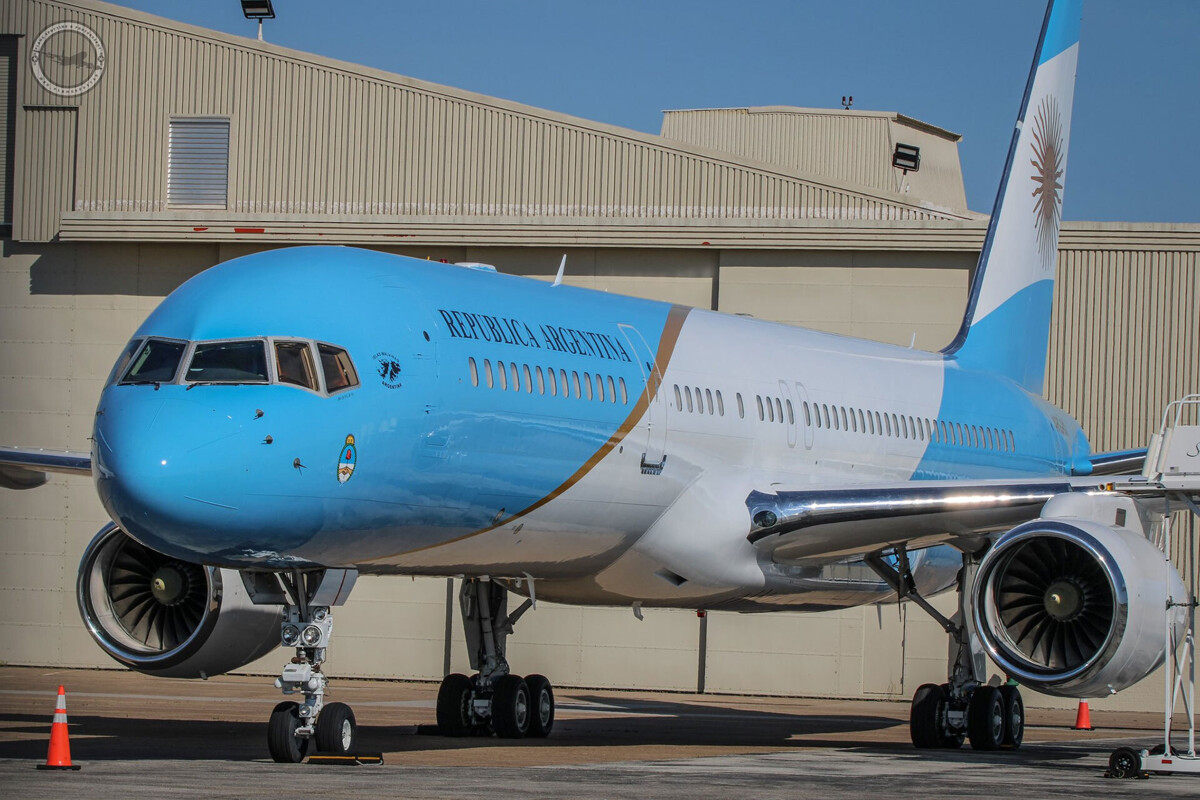
The Argentine presidential aircraft, a Boeing 757-256 (registration ARG-01), arrived in the country in May 2023 following an operation criticized by specialists and opponents, has over time become a true curse for the current administration due to its recurring problems and high maintenance costs.
The most recent malfunction affected one of the auxiliary fuel tanks, a critical system for long-haul flights. The repetition of failures, added to delays in tenders, accumulated expenditure, and technical uncertainty, raise justified questions. To this is added another worrying element: a U.S.-based fuel company has initiated a claim against the Argentine state for a debt of over $350,000 linked to the supply of the presidential aircraft.
The anomaly forced an unscheduled stop in Lima during the last presidential trip to Miami, as the onboard computer blocked the possibility of completing the direct journey. As the years have passed and successive inconveniences have arisen, this criticism has gained greater relevance: the events have demonstrated that the aircraft not only required constant repairs but also became a permanent source of extraordinary expenses and operational problems.
This situation led to the growth of the idea in sectors of civil aviation, the Argentine Air Force, and even the political sphere that it is necessary to form an independent technical commission. Its objective would be to thoroughly evaluate the real state of the ARG-01, the quality of previous maintenance, the compliance with safety protocols, and, above all, the pertinence of it continuing to be used as the presidential aircraft.
Among these works, the costly repair of the right engine reversers for almost $500,000 is counted; the replacement of escape slides and rafts, valued at over $105,000; work on the fuel tanks; and other partial repairs that considerably increased the operational cost of the aircraft.
As a result of this situation, the Military House authorized an emergency tender valued at about $125,000 to repair the defective component, and the aircraft remains these days in a Miami workshop awaiting its return to the country.
This episode adds to a technical history that has generated concern since its arrival. That procedure, finally awarded to the U.S. company Commercial Jet Inc., had a cost of $883,739 after a first failed call in which none of the companies managed to meet the technical and contractual conditions.
To these must be added the previous expenses, which amounted to almost a million dollars in repairs and adjustments just months after its incorporation. Having an aircraft whose technical reliability is a constant subject of review not only represents an operational risk but also an institutional, diplomatic, and budgetary problem.
The conflict, which could lead to a lawsuit in U.S. courts, exposes new facets of the lack of administrative control in the management of the aircraft during previous years. Presidential security demands maximum standards. Another million dollars was also invested in the installation of satellite internet and communications equipment.
The initial purchase, made by the government of Alberto Fernández, had implied an outlay of $21,730,000 and was harshly questioned by specialists due to the general state of the aircraft, its technical configuration, the age of certain components, and the recurring doubt about whether the aircraft was the appropriate option for the transport of the head of state.
The ARG-01 had already been rendered inoperative in June 2024 due to the expiration of the Check-C, the major mandatory inspection imposed by Boeing to ensure airworthiness. The need for a comprehensive audit no longer seems like an opinion: it has become an imperative.